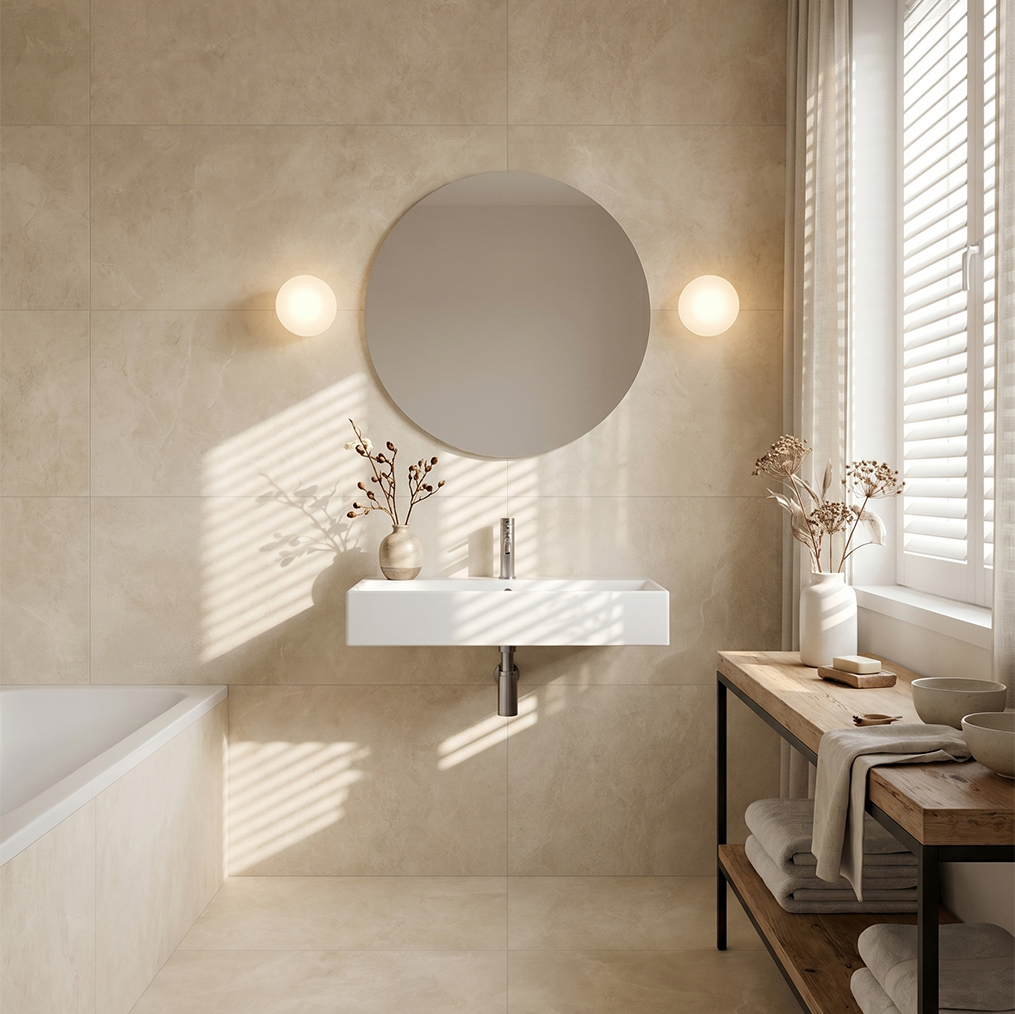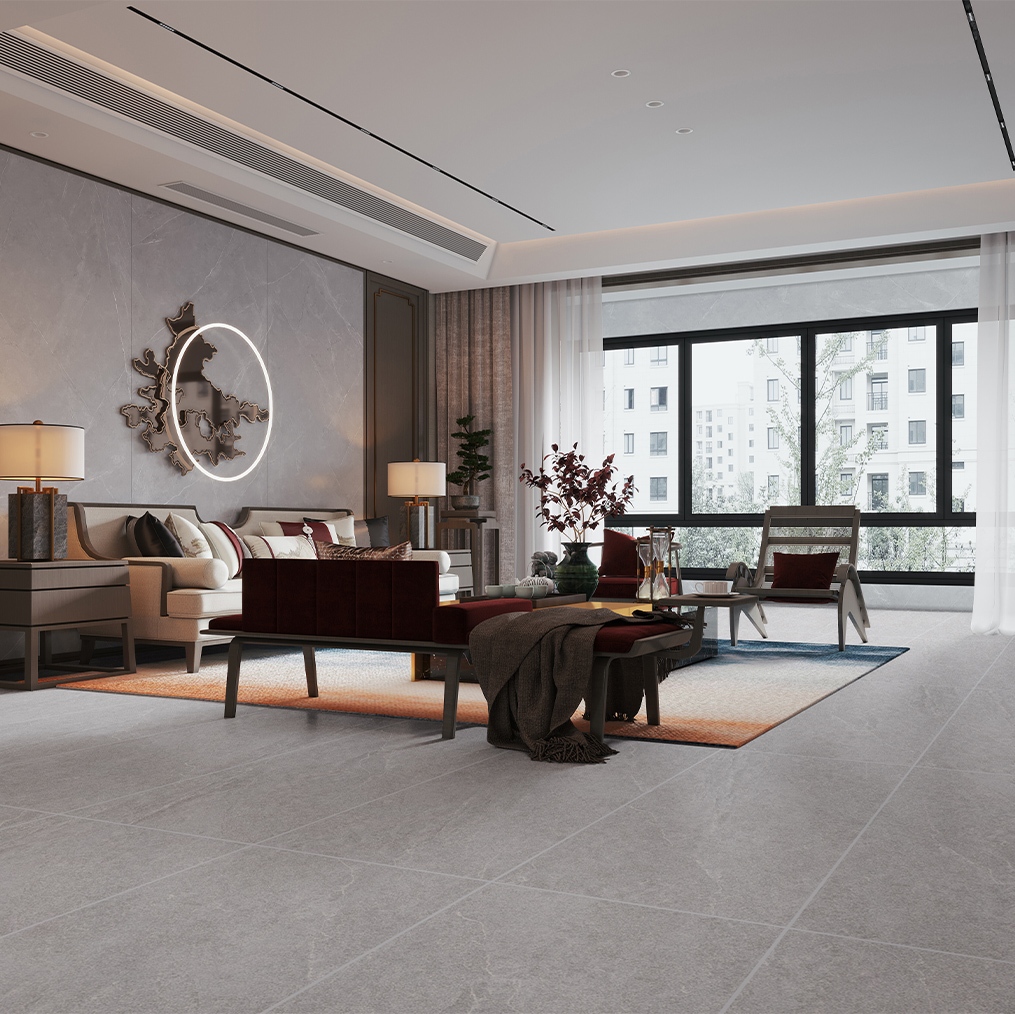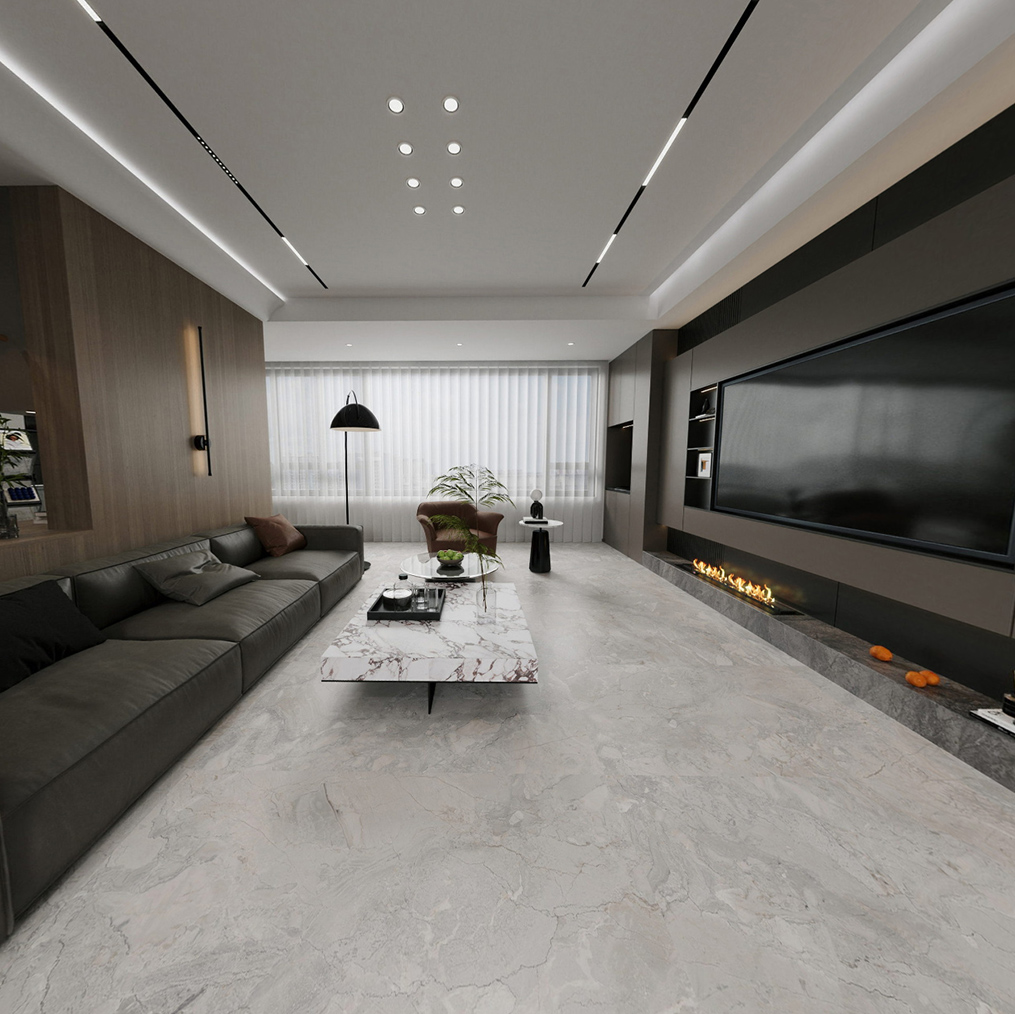

Choosing between materials can become difficult when a bathroom floor is exposed to daily splashes, a kitchen receives dropped pans, or a commercial entrance faces thousands of footsteps. A reliable Porcelain and Ceramic Tile Supplier should explain performance rather than simply recommend the higher-priced product. This guide compares porcelain vs ceramic tile for bathroom projects, the best tile for high traffic floors, and porcelain tile cost vs ceramic, using water absorption, PEI wear rating, and Mohs hardness—the key LSI concepts of rectified edges, through-body color, and glazed tile selection.

Why the Porcelain vs. Ceramic Tile Decision Matters
Both porcelain and ceramic tiles are made primarily from clay and other mineral materials, pressed into shape, dried, decorated, and fired in a kiln. The practical difference is not simply the word printed on the carton. It is mainly related to clay formulation, firing temperature, density, water absorption, dimensional tolerance, and the intended application.
A tile that looks attractive in a showroom may still be unsuitable for a shower wall, an outdoor terrace, or a busy retail floor. Selecting the wrong body can lead to moisture penetration, chipped corners, staining, premature surface wear, or installation costs that exceed the original material budget.
OEM Tile Supplier Comparison: What Is Porcelain Tile?
Porcelain tile is a dense ceramic tile manufactured from refined clay and mineral materials and fired to achieve a water absorption rate of 0.5% or less under the classification commonly associated with ASTM C373 and ISO 13006. The low absorption indicates a compact body with limited open porosity.
Many porcelain products are pressed at high pressure and fired at temperatures commonly around 1,200°C to 1,250°C, although the exact production profile depends on the factory formulation and product type. These tiles may be glazed or unglazed, polished or matte, rectified or non-rectified, and available in formats ranging from small mosaics to large slabs.
OEM Porcelain Tile Supplier: Main Performance Features
- Low water absorption: ≤0.5% for porcelain classification, subject to the applicable test method and product standard.
- High density: The compact body generally resists moisture entry better than higher-absorption ceramic tile.
- Good abrasion performance: Many porcelain floor tiles are manufactured for residential, hospitality, retail, and other demanding applications.
- Through-body or full-body options: In unglazed products, the color and pattern may extend through much of the tile thickness, making small chips less visually obvious.
- Outdoor suitability: A frost-resistant porcelain tile can be appropriate for exterior use when the product has been tested and the installation system is suitable.
- More demanding installation: Dense porcelain often requires a quality diamond blade, a high-transfer thin-set mortar, careful substrate preparation, and an experienced installer.
OEM Ceramic Tile Supplier Comparison: What Is Ceramic Tile?
Ceramic tile is a broad category that includes many clay-based products. In everyday retail language, “ceramic tile” often refers to tiles with a water absorption rate above 0.5%, although the exact classification varies by regional standard and manufacturer. Ceramic tiles can be glazed or unglazed and are produced in a wide range of densities, finishes, and price points.
Wall ceramic tile is often lighter, easier to cut, and less expensive than dense porcelain. It can be an efficient choice for interior walls, backsplashes, decorative panels, and areas where the tile is not exposed to prolonged water or heavy abrasion.
OEM Ceramic Tile Supplier: Main Performance Features
- More design flexibility: Ceramic tile is available in many colors, patterns, relief textures, and decorative formats.
- Lower cutting resistance: Many ceramic products can be cut with less demanding equipment than porcelain, reducing labor complexity.
- Lower purchase price: Entry-level ceramic tile may cost less per square foot, although installation and trim costs still need to be included.
- Suitable for many walls: Ceramic tile is widely used for bathroom walls, kitchen backsplashes, shower surrounds, and interior feature walls.
- Higher absorption in some products: It may require more careful application in wet locations and should not automatically be assumed suitable for outdoor freeze-thaw exposure.
- Potentially lower floor durability: Some ceramic tiles are designed for walls only. The product data sheet must confirm floor suitability and the relevant PEI rating.
Porcelain vs. Ceramic Tile Parameter Comparison from an OEM Tile Supplier
| Parameter | Porcelain Tile | Ceramic Tile | Why It Matters |
|---|---|---|---|
| Water absorption | Typically ≤0.5% for porcelain classification | Often above 0.5%, with a broad product range | Lower absorption is useful in wet, exterior, and freeze-thaw applications. |
| Density | Generally higher | Generally lower, depending on body type | Density influences moisture resistance, weight, and cutting requirements. |
| Hardness | Often approximately Mohs 6–8, depending on glaze and body | Commonly approximately Mohs 4–7, depending on formulation | Mohs hardness indicates scratch resistance, not total impact resistance. |
| Wear rating | Many floor products fall within PEI III–V | May range from PEI I–V; some are wall-only | PEI applies primarily to glazed tile and helps match the surface to foot traffic. |
| Outdoor use | Often suitable when frost resistance and slip data are confirmed | Limited to products specifically tested for the environment | Absorption, thermal movement, drainage, and installation all affect outdoor performance. |
| Cutting and drilling | Usually more difficult; diamond tools are recommended | Usually easier to cut and drill | Labor time and tool wear can affect the installed cost. |
| Weight | Often heavier per square meter at the same thickness | Often lighter | Wall substrate capacity and delivery costs should be reviewed for large projects. |
| Typical material price | Approximately $3–$15+ per square foot | Approximately $1.50–$10+ per square foot | Actual prices vary by size, finish, design, certification, region, and order volume. |
These figures are practical ranges rather than guarantees. A premium ceramic tile can outperform an entry-level porcelain tile in surface design or glaze quality, while a low-cost porcelain tile may have limited shade consistency or rectification. Always compare the complete technical sheet, not only the product name.
OEM Tile Supplier Guide to Scenario-Based Selection
Porcelain vs. Ceramic Tile for Bathroom Floors and Walls
For a bathroom floor, porcelain is usually the safer default when the room receives frequent water, wet footwear, or heavy household use. Choose a matte or structured surface with documented slip-resistance data rather than selecting a highly polished surface solely for appearance.
Ceramic tile is often a practical choice for bathroom walls and decorative areas. A homeowner may use porcelain on the floor and ceramic on the walls to control the budget without compromising the floor’s moisture and wear requirements. In a shower, the waterproofing membrane, slope, grout, movement joints, and tile surface all matter; a low-absorption tile does not replace a correctly installed waterproofing system.
OEM Tile Supplier Advice for Kitchens and Backsplashes
Kitchen backsplashes usually do not need the same abrasion resistance as a commercial floor. Ceramic tile can provide a broad design range at a lower material cost and is generally easier to cut around sockets, corners, and cabinets.
For a kitchen floor, select a product rated for floor use and evaluate PEI, coefficient of friction or slip-resistance information, stain resistance, and grout maintenance. Porcelain is often preferred for open-plan kitchens that connect to entrances or dining areas because sand and grit can act as abrasives.
OEM Porcelain Tile Supplier Options for Outdoor Patios
Exterior patios require more than a “porcelain” label. Confirm water absorption, frost resistance, slip performance, thickness, installation method, and suitability for the local climate. In freeze-thaw regions, absorbed water can expand during freezing and contribute to cracking or delamination.
For balconies and terraces, drainage is equally important. A dense tile installed over a poorly sloped substrate can still experience failures because water remains trapped below or around the system. Use an exterior-rated adhesive, flexible grout where appropriate, movement joints, and edge detailing specified for the project.
OEM Ceramic Tile Supplier Recommendations for Interior Walls
Interior walls, feature walls, fireplace surrounds, and low-impact decorative installations are often suitable for ceramic tile. Its lower weight and easier cutting can be useful in renovations where installers need to work around existing cabinets, plumbing, or uneven room geometry.
Large ceramic wall tiles may reduce grout lines, but the wall must be flat enough to support the format. For large-format porcelain, the substrate tolerance and mortar coverage become even more critical because minor variations are more visible across a large surface.
Porcelain Tile Cost vs. Ceramic: A Complete Price Analysis
Material price is only one part of the budget. A realistic comparison should include tile, waste, trim, adhesive, grout, waterproofing, substrate repair, delivery, cutting, demolition, and labor.
| Cost Component | How Porcelain Can Affect the Budget | How Ceramic Can Affect the Budget |
|---|---|---|
| Tile purchase | Often higher, especially for large formats, polished finishes, marble looks, and technical surfaces | Often lower for standard sizes and mass-market designs |
| Installation labor | May increase because dense tile needs diamond cutting, accurate layout, and stronger handling procedures | May be lower when the format is small or medium and the substrate is ready |
| Waste allowance | Typically 10% is used for straightforward layouts; 15% or more may be needed for diagonal layouts or complex patterns | Similar waste planning applies; lower material price does not eliminate layout waste |
| Long-term replacement | Low absorption and strong wear performance can reduce replacement risk in demanding areas | Can provide good service life when correctly matched to walls or moderate-use floors |
For example, a 200-square-foot kitchen floor might require 220 square feet of tile with a 10% waste allowance. If porcelain costs $6 per square foot and installation totals $8 per square foot, the tile and installation portion is approximately $3,080. A ceramic option at $3 per square foot with $7 installation would total approximately $2,200 for the same 220 square feet. The difference is $880 before adhesive, grout, demolition, substrate repair, and trim.
The lower-cost option is not automatically the better financial decision. If the location is exposed to heavy grit, moisture, or freezing temperatures, the cost of removing and replacing a failed installation can exceed the original material savings.
Real-World User Case: Choosing Between Porcelain and Ceramic Tile
Consider a documented-style homeowner scenario commonly reported by renovation contractors: a family renovating a 60-square-foot bathroom wanted a stone-look floor and a patterned wall. Their first plan used one ceramic product throughout because the carton price was lower. During product review, they discovered that the proposed tile was wall-rated and did not provide the required floor-use or slip information.
The revised specification used a matte porcelain tile for the floor and a lighter ceramic tile for the walls. The porcelain floor material cost about $180 more than the original floor selection, but the ceramic wall tile reduced the wall-material budget by approximately $120 compared with using porcelain everywhere. The final material difference was about $60, while the project gained a floor product with documented floor suitability and lower water absorption.
The practical lesson is not that porcelain must always be used. It is that the tile should be assigned by location: floor or wall, wet or dry, interior or exterior, light or heavy traffic. Ask the supplier for absorption, PEI, slip, shade variation, caliber, and recommended application data before placing the order.
User Word-of-Mouth Evaluation of Porcelain and Ceramic Tile
Common Positive Feedback About Porcelain Tile
- Homeowners often value its resistance to moisture and the availability of realistic stone, concrete, and wood-look designs.
- Retail and hospitality users frequently prefer porcelain for entrance areas because many products are available in higher wear classes.
- Owners of pets often report that dense, correctly glazed porcelain is easier to clean after spills, although grout remains the most maintenance-sensitive part of the floor.
Common Complaints About Porcelain Tile
- Installers report that inaccurate cuts, insufficient mortar coverage, and uneven substrates are more noticeable with large-format porcelain.
- Homeowners sometimes underestimate delivery and handling costs because dense tile weighs more.
- Polished porcelain can show water spots, footprints, and scratches more clearly than a textured matte surface.
Common Positive Feedback About Ceramic Tile
- Renovation users appreciate its lower entry price and easier cutting around outlets, pipes, and irregular corners.
- Design-focused buyers often choose ceramic for decorative walls because color, relief, and small-format options are widely available.
- Many users find ceramic wall tile easier to handle during DIY projects, provided the selected product is rated for the intended application.
Common Complaints About Ceramic Tile
- Some buyers discover after purchase that a decorative ceramic tile is not approved for floors.
- Higher-absorption products may be inappropriate for exterior installations or areas exposed to prolonged saturation.
- Soft or glossy surfaces can show scratches, glaze wear, or stains more readily in high-traffic locations.
Objective Ranking: Which Tile Is Better for Different Buyers?
| Rank | Project Type | Preferred Choice | Reason |
|---|---|---|---|
| 1 | Outdoor patio in a freeze-thaw climate | Certified exterior porcelain | Low absorption and frost-tested performance reduce moisture-related risk. |
| 2 | Busy residential or commercial floor | Porcelain with suitable PEI and slip data | It commonly offers a dense body and a wider selection of heavy-use products. |
| 3 | Bathroom floor | Porcelain or certified floor ceramic | Surface grip, floor rating, and installation quality matter as much as body type. |
| 4 | Kitchen backsplash | Ceramic or porcelain | Choose based on design, cleaning, budget, and cutting requirements. |
| 5 | Interior feature wall | Ceramic is often sufficient | Lower weight, easier cutting, and decorative variety can provide better value. |
| 6 | DIY renovation with basic tools | Small or medium ceramic tile | It is generally easier to cut, handle, and replace during a first installation. |
How JBN Can Help as an OEM Tile Supplier
JBN can be evaluated as a sourcing partner by requesting the same information that should be required from any professional tile manufacturer: product classification, water absorption test results, dimensions and caliber, shade variation, PEI or equivalent wear data, slip-resistance information, packing details, available sizes, minimum order quantity, lead time, and quality-control procedure.
For distributors and project buyers, an OEM supplier should also provide coordinated colors, matching trims, samples, batch control, carton labeling, and export packaging. These details reduce the risk of receiving tiles that differ in tone, thickness, or actual application from the approved sample.
JBN’s advantage should be judged by documented consistency and project fit rather than by brand claims alone. Request physical samples, compare them under the project’s lighting, review the technical sheet, and confirm that the production batch matches the approved specification before committing to a large order.
Selection Checklist from an OEM Porcelain and Ceramic Tile Supplier
- Define the location: bathroom floor, shower wall, kitchen backsplash, commercial floor, patio, or another application.
- Check water absorption: confirm whether the product meets the requirements for the climate and wet exposure.
- Confirm floor or wall rating: never assume a decorative wall tile can be used underfoot.
- Review PEI: for glazed floor tiles, match the wear class to expected traffic and abrasive dirt.
- Review slip data: especially for bathrooms, entrances, kitchens, ramps, and outdoor spaces.
- Measure the substrate: large-format tiles require a flatter base and more precise installation.
- Calculate total installed cost: include waste, labor, cutting, adhesive, grout, trim, delivery, and preparation.
- Order samples: inspect color, texture, shade variation, edge quality, and cleanability.
- Keep spare tiles: retain approximately 2%–5% extra for future repairs, depending on product availability and layout complexity.
- Confirm batch details: purchase enough tiles from the same caliber and shade batch whenever possible.
FAQ: Porcelain vs. Ceramic Tile and OEM Tile Supplier Questions
Is porcelain tile better than ceramic tile?
Porcelain is generally better for high moisture, outdoor, freeze-thaw, and high-traffic applications when the product has the correct technical ratings. Ceramic may be better for interior walls, backsplashes, decorative areas, and projects where easier cutting and lower material cost are priorities.
Can ceramic tile be used on a bathroom floor?
Yes, but only if the specific product is rated for floor use and provides suitable slip and wear information. Ceramic tile varies significantly; a wall-only product should not be installed on a floor.
Can porcelain tile be used on walls?
Yes. Porcelain can be installed on walls when the substrate, adhesive, tile weight, format, and local installation requirements are suitable. Large or thick porcelain may require additional handling and support planning.
Is porcelain tile harder to install?
It can be. Its density often requires diamond cutting tools, careful drilling, adequate mortar coverage, and a flatter substrate. Installation skill can have a greater effect on the final result than the body type alone.
Does porcelain tile crack less than ceramic tile?
Not automatically. Porcelain has a dense body, but any tile can crack if the substrate moves, the mortar coverage is poor, the joints are incorrectly designed, or heavy loads are concentrated on unsupported areas.
Which tile is easier to clean?
A properly glazed, low-porosity tile is usually easy to clean, whether porcelain or ceramic. Surface texture, polish, grout type, and maintenance frequency often influence cleaning more than the label on the carton.
What is rectified porcelain tile?
Rectified tile is mechanically finished after firing so that its edges are more dimensionally consistent. It can support narrower grout joints, but it still requires correct joint width, layout, substrate flatness, and movement accommodation.
Should I buy porcelain or ceramic tile from an OEM supplier?
Choose an OEM supplier when you need repeatable specifications, coordinated collections, private labeling, project quantities, packaging control, or custom sizes and finishes. Before ordering, verify samples, certificates, production tolerances, quality inspection, lead time, and after-sales procedures.
Final Recommendation: Who Should Choose Porcelain or Ceramic?
Choose porcelain if you need a low-absorption tile for a busy floor, wet zone, exterior project, or freeze-thaw environment and your budget supports the material and installation requirements. Choose ceramic if you are tiling an interior wall, backsplash, decorative feature, or moderate-use area where design flexibility, lighter handling, and lower initial cost are more important. Neither material is universally superior: the correct choice depends on application data, installation quality, climate, traffic, maintenance, and total installed cost.
To make the next decision, send JBN your project location, square footage, intended application, preferred size, surface finish, climate, and target budget. Request samples and a technical comparison for porcelain vs ceramic tile for bathroom projects, the best tile for high traffic floors, and porcelain tile cost vs ceramic. Compare the LSI factors—rectified edges, through-body color, and glazed tile—alongside the professional specifications of water absorption, PEI rating, and Mohs hardness before placing an order with an OEM Tile Supplier.