13,Aug 2026
What Is the Water Absorption Rate of Porcelain Tile and Why Does It Matter? It is the percentage of water a tile body absorbs after being dried, weighed, immersed, and weighed again. The basic calculation is: Water Absorption (%) = [(Saturated Weight − Dry Weight) ÷ Dry Weight] × 100. For porcelain tile, the industry benchmark is generally 0.5% or less, tested according to standards such as ASTM C373, ISO 10545-3, or EN 14411. For an OEM Tile Supplier, this measurement helps determine whether a product is suitable for bathrooms, façades, commercial floors, exterior areas, and freeze-thaw conditions—directly affecting project durability, warranty risk, and purchasing decisions.
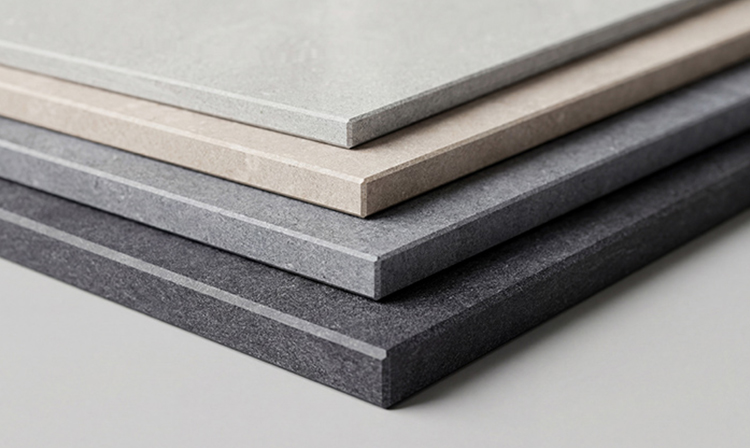
Water absorption describes how much moisture enters the tile’s fired ceramic body. A lower percentage normally indicates a denser, more vitrified body with fewer interconnected pores.
| Tile classification | Typical water absorption | Common standard reference | Typical applications |
|---|---|---|---|
| Porcelain tile, Group BIa | E ≤ 0.5% | ISO 13006 / EN 14411 | Exterior floors, commercial spaces, wet rooms |
| Low-absorption ceramic tile | Above 0.5% to approximately 3% | ISO 13006 groups BIb and BIIa | Interior walls and selected floors |
| Standard ceramic wall tile | Often above 10% | ISO 13006 Group BIII | Interior walls and decorative applications |
The exact classification depends on the applicable standard, manufacturing process, and product specification. Buyers should always review the supplier’s test report instead of relying only on the word “porcelain.”
Under ASTM C373 or ISO 10545-3, laboratories generally:
For example, if a tile weighs 1,000 grams when dry and 1,003 grams after saturation:
[(1,003 − 1,000) ÷ 1,000] × 100 = 0.3% water absorption
That result falls within the commonly accepted porcelain threshold of 0.5% or less.
Water absorption is not simply a laboratory number. It influences how a tile performs throughout its service life.
In cold climates, absorbed water can freeze and expand inside the tile body. Repeated freeze-thaw cycles may cause:
A dense porcelain body with E ≤ 0.5% is generally better suited to exterior applications, although the complete installation must also include suitable adhesive, grout, movement joints, drainage, and substrate preparation.
Bathrooms, kitchens, swimming-pool surrounds, balconies, and laundry rooms are exposed to continuous or intermittent moisture. Low absorption reduces moisture penetration through the tile itself.
However, tile is not the entire waterproofing system. A tile with low absorption does not replace:
A denser tile body generally offers fewer pathways for liquid stains. This can simplify cleaning in restaurants, hotels, hospitals, retail stores, and transportation facilities.
Still, stain resistance also depends on the glaze, surface texture, polishing treatment, grout, and the chemical composition of the contaminant. Low water absorption alone does not guarantee complete stain-proof performance.
For developers, architects, distributors, and contractors, the absorption rate supports more accurate product selection. It can help a project team:
This is why a professional Porcelain and Ceramic Tile Supplier should provide technical data, batch traceability, and test documentation—not only color samples and marketing claims.
Ceramic tile manufacturing developed from traditional clay firing into highly controlled industrial production. Early tiles often had relatively porous bodies and required glazes or restricted indoor use. As pressing technology, spray-dried powders, fast-firing kilns, and digital decoration improved, manufacturers were able to produce denser vitrified bodies.
The term “porcelain tile” became associated with a highly compact ceramic body, but international markets do not always use terminology consistently. For that reason, modern procurement relies on measurable classification systems.
Important references include:
A credible Porcelain and Ceramic Tile Supplier should identify which standard was used, the sample size, the test date, and whether the result applies to the actual production series.
For an OEM or private-label project, the absorption rate should be treated as one part of a broader technical specification.
Ask for the following before approving a product:
For dimensional quality, a project specification may require inspection against calibrated equipment with readings recorded to 0.01 mm, depending on the product and tolerance system. A robust production-control program may also include 100% visual inspection for critical appearance defects and a documented 24-hour response process for technical or quality claims.
These requirements help a buyer distinguish a production-capable Porcelain and Ceramic Tile Supplier from a trading company that cannot control the factory process.
No ceramic tile body is perfectly free of pores. The relevant requirement is usually 0.5% or less, not zero absorption. A result of 0.2% and a result of 0.5% may both meet the porcelain classification, but they do not represent exactly the same performance margin.
Water absorption and slip resistance measure different properties. A polished tile may have low absorption but become slippery when wet. Select the surface finish using the project’s slip-resistance requirements, traffic conditions, and local building regulations.
Many dense porcelain tiles do not require sealing for the tile body. However, polished surfaces, textured finishes, cementitious grout, and certain installation conditions may benefit from a suitable sealer. Always follow the manufacturer’s care instructions and conduct a small test area.
Exterior durability also depends on:
A tile can meet the absorption requirement and still fail if water becomes trapped beneath it or the installation system is unsuitable.
Terms such as “vitrified,” “full body,” or “porcelain” should be supported by test data. A reliable Porcelain and Ceramic Tile Supplier should be able to provide a current laboratory report or factory quality record for the specified product and batch.
A hotel renovation team is comparing two floor tiles:
Tile A is the stronger technical choice for a wet, high-traffic environment because its body is denser and its surface specification is more appropriate. The procurement team should still verify grout compatibility, wet-area waterproofing, cleanability, and slip resistance.
The project should also request pre-production samples, confirm shade and caliber, and approve a written technical datasheet before mass production. If JBN is being evaluated as an OEM Tile Supplier, the buyer should ask JBN to confirm the applicable standard, production batch, inspection procedure, and packaging method for the selected collection.
An architect specifies porcelain pavers for an outdoor terrace in a region with repeated freezing temperatures. The supplier submits a water absorption report showing 0.4%, which meets the common porcelain criterion.
That is a positive starting point, but approval should not stop there. The project team should also verify:
This step-by-step review prevents the common error of treating water absorption as the only durability indicator.
When sourcing from JBN, buyers should evaluate both product performance and supply-chain capability. A professional review can include:
For a long-term program, the purchase contract should define the approved product specification, allowable variation, inspection method, sampling plan, and documentation requirements. This is especially important when the same tile will be supplied to multiple projects or markets.
Use this checklist when comparing an OEM or wholesale source:
The water absorption rate of porcelain tile measures how much moisture the fired tile body can take in, with 0.5% or less commonly defining porcelain under ISO and EN classification systems. It matters because it influences moisture resistance, freeze-thaw suitability, staining behavior, maintenance, and long-term project risk.
For accurate purchasing, do not evaluate absorption in isolation. Combine the laboratory result with slip resistance, frost performance, dimensional control, surface finish, installation design, and supplier reliability. Whether you are comparing JBN or another Porcelain and Ceramic Tile Supplier, request current ASTM or ISO test data, verify the production batch, and approve the complete technical specification before placing a large OEM order.
Feel free to reach out for any queries. We would be happy to help!
We look forward to working with you.
Navigation
Navigation
Contact Us
Telephone: 0086-757-83327093
E-mail: jbn002@jbnjbn.com
WhatsApp: +86 136 9028 1303
WeChat: +86 136 9028 1303
Address:Building 4, Area B, Ceramics International Trading Center, Jihua Xi Road, Foshan, Guangdong, China
Get in Touch
Get in Touch